
What I really wanted to do today was to stay in bed reminiscing about the opening of my art show on Saturday and how much fun I had. But I needed to finish writing a long freelance article I’d been assigned before indulging.
Now it’s early Monday morning and I’m sitting here at the computer grinning. Maureen, who was in charge of hanging and coordinating my show at The Whitney Gallery, told me not to be discouraged if only a few people made it to the opening because sometimes this happens.
But I wasn’t worried. One of the good things about having a large family is that you know they will always support you whether or not they’re in the mood, so at least 12 of them showed up plus a boyfriend and a fiancée, along with a ton of friends, neighbors and art buddies. Okay, so I don’t know how much a ton is, but it was a heartwarming number. Mary, Lennie, Nancy, Cori, June, Lanre, Cherri and Karen all stopped in to visit along with Bill, Andrea, Yvonne, Peter, Steve, Al, Peggy, Doug, Carolyn, Kim, Diana, Dave, Susan V and husband, Rosemary and Jeanette—if I’ve forgotten to mention you, I apologize. At one point Maureen told me that 118 people had been in to look at my work, so there were obviously lots of people I didn’t know, but I enjoyed meeting quite a few of them.
Naturally I had a great time gabbing to everyone and signing copies of my book Creating from the Inside Out. (Speaking of my book, I’ll have more to say on that subject very soon). There were several highpoints including meeting Lennie (my online pal and Photoshop guru), and being taken out to a big family dinner afterwards by my sister Pam and brother-in-law Brian.
John is putting together a slide show of the event which he plans to put on the website he’s working on for me. In the meantime, here’s a 16 x 20” mixed media canvas, When Destiny Calls, which will be heading for its new home when the show is over on November 15th.
 Apparently it was Duke Ellington who said: “I don’t need time; I need a deadline.” I’ve always thought that was a great quote because there’s nothing like a deadline to sharpen your focus and concentrate your energy. But when you actually have one that’s unavoidable—like I do with my upcoming show—the gift of more time would be a spectacular bonus. (However, I also know that work will continue to expand as long as there’s space available).
What I’ve discovered over the past few months is that no matter how single-minded you are and how solid your work ethic is, three things are certain:
First—anything you do (especially if it’s important to you) is going to be way more complicated than you thought it would be.
Second—it’s also going to take you about three times longer than you planned …if you’re lucky.
Third—being in control is a complete illusion. Just when you think you’re organized and ahead of the game, something happens to turn that perception inside out.
There have been many moments when I’ve considered bailing out altogether because what I first envisioned won’t be appearing in a gallery anytime soon—if ever. This experience has turned into a finishing off of things I wanted to finish, and a saying goodbye to others. I’m sure there are plenty of life lessons here that I could be more aware of and thoughtful about, but all I can think is: only ten more days and I’ll be free to indulge in a marathon of socializing, reading trashy novels, watching a ton of TV, and yes, doing more blogging.
 I owe Carmi Cimicata a big thank you for the care package of vintage photos she mailed to me last week. Let me tell you, it acted just like catnip to my Leo senses—I think I actually meowed.
Anyway, in amongst the pictures Carmi sent me was this one of a baby with the face and posture of a grown up, and written on the back was “Byron Blackthorn Hawksridge 2nd, Aged 10 months.” Yes, I know it sounds like the name of a hero in a romance novel, and while Byron is actually the baby’s first name, I changed the other two to preserve his privacy. But his middle and last name are actually more interesting than the ones I chose for him.
The reason I want to protect his identity is because I decided to do a web search for him after talking to Mary. (Mary Ambrose—in case you don’t know it—has her private investigator’s license, a feat she accomplished while she was pregnant with her son Hayden).
Now where was I? Oh yes, so I did a search for Byron, and first found his namesake and grandfather who was born in 1835, hated his name Jedediah and changed it to Byron. To make a long story short, through an obituary, I eventually tracked down one of Byron II’s daughters in the U.S. and offered to send her the photo of her dad. She was thrilled to hear that there was a baby picture of him in existence. Between us, we figured out that the photo was probably taken in 1918 and sent to a Canadian relative by Byron’s mother in Maine. Naturally I’d like to know more about Byron (who was an engineer), but I didn’t want to seem pushy.What was gratifying to me about this experience was not only to find out there was a real person behind one of the images I like to work with, but that I was also to be able to send Byron’s three daughters a precious memento of their dad. So thank you Carmi for this heart-warming experience. I couldn’t alter Byron’s image though. Somehow it didn’t seem right.
 I’d like to extend an invitation to all of my readers who can make it to come to the opening of my art show on Saturday, October 3rd between 2 and 4 pm at the Whitney Community Gallery in Brampton.
The gallery is part of the Peel Heritage Complex, which includes our regional archives, a museum, a 19th century jail and the Art Gallery of Peel.
My show runs from October 3rd to November 15th and will include mixed media, digital collage and assemblage. I’ve called it Creating from the Inside Out—after the title of my upcoming book—and if all goes well with the publishing end of things, I should have some copies of my book available at the opening too. The Whitney Gallery is located at 9 Wellington St. East in Brampton and you can visit Monday to Friday from 10 am to 4:30 pm; Thursday evenings from 6 to 9 pm; and Saturday and Sunday from noon to 4:30 pm.

 I’ve had a few phone calls and emails lately asking me if I’m okay—and whether or not I’m still planning to post to my blog. Of course I am. Things just seem to have gotten away from me in the past few weeks though. I haven’t written in my journal for over a month now either.
The problem is: the longer you put off writing a blog entry, the harder it becomes to do one. Instead of it being a natural and spontaneous action, you start questioning if you actually have anything worthwhile to say. Not that I don’t have good reasons for being a blogcrastinator—writing articles, getting ready for my show, preparing my book for the printer, having the flu and so on. But thinking back, I guess the only fun thing I haven’t let slide is Photoshop. I took these two pictures of flowers on my daily walk and then combined them with a couple of textures Lennie posted to her blog on August 21st. There’s nothing like playing around with other people’s photos to get me back in the swing of things. So thanks Lennie. I owe this post to you.
 Last Monday Irene was tagged by Leslie to take fifteen minutes and make up a list of fifteen books that have stayed with her—so, of course, I had to make up a list too.
But I limited mine to novels because it was just too overwhelming to make decisions otherwise.
In no particular order (and with some ganging up), here is my list:
The Emily Trilogy by Lucy Maud Montgomery
Franny and Zooey by J.D. Salinger
Trust Me and Hidden Talents by Jayne Ann KrentzHis Dark Materials Trilogy (The Golden Compass, The Subtle Knife, The Amber Spyglass) by Phillip Pullman
The Chronicles of Narnia (particularly The Voyage of the Dawn Treader) by C.S. Lewis
Inner Harbor by Nora Roberts
Gone with the Wind, Margaret Mitchell
Neverwhere by Neil Gaiman
Weaveworld by Clive Barker
The Secret Garden by Frances Hodgson Burnett
Lord of the Rings by J.R.R. Tolkein
The Shining by Stephen King
The Tales of Alvin Maker by Orson Scott Card
The Complete Sherlock Holmes by Arthur Conan Doyle
Pride and Prejudice by Jane Austen
I think it’s obvious from my list that I was never an enthusiastic English literature student even though I have a B.A. in the subject. I like mystery, fantasy, science fiction, romance, the occasional horror novel and books about individualistic children finding their true path in life.
The only one I actually recall studying in university was Pride and Prejudice. But I didn’t appreciate it until I saw Colin Firth as Mr. Darcy in the 1995 TV mini series. The fact that several people phoned afterwards to say that Colin Firth looked like my husband obviously affected my judgment.
As to the other books on my list, each choice was an instinctive one. I think the books you gravitate to are like the people you hold dear. You can’t always explain the attraction, you just know it’s there, so the best thing to do is just go with the flow.
 Because of everything else that’s going on in my life, I haven’t been able to blog as often as I’d like to for a while now. So tonight I was thinking: I wonder if I can Photoshop something in five minutes and then post it? Five minutes went by, then ten and twenty, and I finally got something that seemed okay to me a half an hour later.
Whoever my muse is, he/she just hates to be rushed. In fact he/she really just prefers to sit around ruminating and puttering (rather than actually encouraging me to finish things off).
This started me thinking about doing things slowly. I know there’s a whole slow food movement that’s really, really popular all over the world. In fact if you google slow food, you’ll get at least 300,000,000 hits.
But what about slow art? Turns out it’s popular too. There are actually people around who will spend several months working on a postage stamp sized piece of art.
“Slow is used as a term of respect for the way art is made and how it is best viewed,” says artist Deborah Barlow. And here’s another quote I love:
What we need more of is slow art: art that holds time as a vase holds water: art that grows out of modes of perception and making whose skill and doggedness make you think and feel; art that isn’t merely sensational, that doesn’t get its message across in ten seconds, that isn’t falsely iconic, that hooks onto something deep-running in our natures. In a word, art that is the very opposite of mass media. (Art critic Robert Hughes)Cool, eh? Looks like I’ve finally found my tribe. But I think I’m going to take my time getting to know them.

For anyone who is would like to learn Photoshop, but is apprehensive about it, here’s some inspiration. Five years ago, at the age 87, fashion photographer Lillian Bassman decided to tackle the program. She spends six or seven hours a day playing in Photoshop and says it has opened up a whole new world for her.
The interesting thing is that Bassman is a Photoshop girl only—no Google or email for her. To see some of her work and to read more about her life, check out this article in the New York Times. Now here’s something else that's cool. Did you know that you can paint using your iPhone? Apparently you download this program called Brushes, a low-priced software application that has a color picker, zooming, virtually unlimited undo and redo, and a set of realistic brushes. You can also export your paintings at high resolution (up to 1920 x 2880), and turn them into QuickTime movies. See the video below.
 I buy most of my books online because there are no bookstores in my neighborhood. And of course it doesn’t hurt that Amazon and Chapters have lower prices, which means you end up getting more books in the long run. The problem is you don’t always get the chance to look at the books you want first.
Take Art Journals & Creative Healing by Susan Soneff for example. The main reason I bought it was to finish off the amount on a gift card. Once the book arrived, I took a quick look at it and then set it aside.
Why? Because it looked like heavy-duty stuff to me and I’m usually in the mood for eye candy. As someone who has struggled with depression off and on for most of her adult life, I like to avoid the negative and just peace out. But for months now, Soneff’s book has been sitting around waiting for me to notice it, so I finally took a deep breath and plunged in.
Just as I suspected, there were plenty of soul-wrenching moments inside. Women with everything from anorexia and cancer, to depression and MS share their personal stories and journal entries. While there are visually moving pages here, and plenty of creative tips, the main emphasis is on being brave enough to chronicle your journey through words and images.
Even though journaling is used in clinical and therapeutic settings, and research supports the benefits, I have to admit I’m skeptical. I say this because writing in my journal allows me to vent, but I can’t say it helps me; it simply seems to be something I’m in the habit of doing.
However, it occurred to me while I was working through Soneff’s book that I’m in a rut. Like a hamster on her wheel, I do what I do and forget to focus on choices or different perspectives. In short, I don’t go that deeply into things when I journal, although it may seem like it when I’m upset. I’ve thought quite a bit about this book since I finished it last week. In the next couple of days, I’ll be finishing off my current journal and I’ve decided that I need to take a different approach. I’m not sure what this will be, but I think it’s time to be more honest with myself, so I’ll let you know what happens.
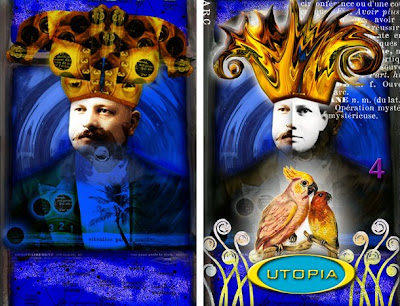
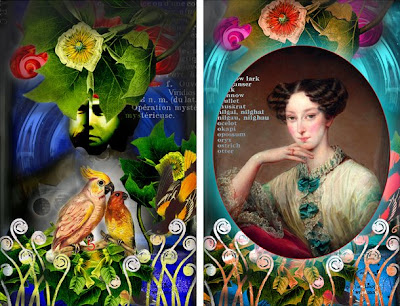 Jeanne and I have been volleying in Photoshop for a couple of years now. We take turns altering a photo until we’ve reached the magic number ten, and then we start all over again.
We’ve been more off than on for months now mainly because life has been complicated for both of us. Even so, one of us always manages to pick up the ball and volley back at some point. I’m feeling pleased with myself that I managed to finish volley six of this round yesterday …only four more to go!
(I posted one and two of this round back at the end of February if you want to check them out. At this rate we should be finished by Christmas).
 Have you ever noticed that when an image rivets your attention, trying to express that feeling seems to elude you?
Take this doll for instance. Mary gave he/she/it to me last year and I find it weirdly captivating. I don’t know whether it’s the way the doll feels, its markings or even the hole in its head. Whatever is going on, I can’t make sense of it. I just know I’m hooked, and for months now, I’ve been moving the doll from assemblage to assemblage where it's always restless, and never quite at home.
I wondered what would happen if I took some pictures and then played with them in Photoshop. Well, no luck there either. I kept wishing that I had the Lennie gene and could at least have started the process with a decent photo.But looking at the results now, I think the best approach would be to wrap the doll in some kind of fabric and just pretend something real was actually going on inside.
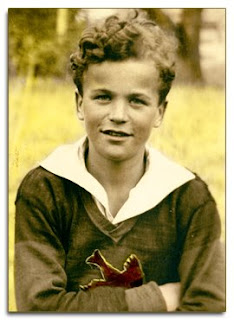 One of the satisfying things about working in Photoshop is being able to give an old photo new life, or in some cases to repair the damage done by time and careless handling. My guess is that this picture of my Uncle Ken was taken in the early thirties, and the photographer hand-tinted the bird on his sweater and the grass in the background (which was probably green to begin with). After I’d scanned the photo and got it on-screen in Photoshop, I could see this “painting” was crudely done, but I decided not to alter the color, just brighten it up.
You will get some idea of the original state of Uncle Ken’s photo if you compare it to the one taken of my father at the same time (see below left). Restoring Dad’s childhood picture is probably the most difficult task I’ve attempted in Photoshop. The vertical creases through his face were really challenging to repair. I actually thought re-working the eye area would be the hardest, but it turned out to be the chin. Go figure.The interesting thing about photo retouching is that each picture presents its own set of visual problems that need to be solved. While the tools to do this are available in Photoshop—I use the Clone Stamp and Spot Healing Brush tools the most—in the end it’s more about the moment-to-moment creative decisions you make than anything else.
 I rarely re-read entries I’ve made in my journal because I’ve found I don’t like what I’ve written—or more accurately, I don’t like to be reminded of the mood I was in at the time. I know some people use their journal to celebrate, but I tend to write in mine when I want to ponder the meaning of life, or to whine.
On the other hand, I don’t mind revisiting the art I’ve done—even if I don’t like it. My collages and drawings have their own kind of memory that has nothing to do with how I’m feeling about the events of my life at the time. In this journal I used dollar store paints for my backgrounds. It’s not the kind of paint I’d use on canvas because it’s too thin and has a chalky texture when it dries. But I’ve found it works just fine on the paper in a Moleskine sketchbook. I like the two green pages below mainly because of the stamped dress. Anything paper-dollish appeals to me for some reason …maybe because I got so much pleasure from playing with paper dolls as a child.
 What I remember about the red pages at the beginning of this post is how annoyed I was by the way they turned out. It was the first time I’d used a Copic marker and I really disliked how thickly I drew the lines around the map shapes. Normally I would have just obliterated what I’d done and started again. However, there’s something about being almost at the end of a journal that makes you anxious to finish it, so I let them be.
  I think I was feeling much the same way when I did these last two pages of the journal. When in doubt, Stick in a Parrot is my motto. Well, not really. But what a parrot represents to me is Joseph Cornell (with maybe a splash of Monty Python?) In any case, if you have an image that appeals to you, just pop it in when you feel stuck. It may not do anything to improve what you’re working on, but at least you’ll feel good using it.
 I thought I’d show you some of the pictures I took yesterday when I was at my friend Bev’s for an art day. Six of us got together to play with alcohol inks on bamboo tiles, dominos and clear plastic—and later on, pouring UTEE into molds.
A few months ago Mary taught me how to make molds. I was really pleased with how they turned out at the time, and took them along to our playday. By the time we got to that point, though, my camera had run out of juice.
Because I’d posted photos earlier in the week of different art tables, I really noticed how people worked yesterday. Some were messy, some were neat, and still others (like me) seemed to swing wildly from one end of the spectrum to the other.
What I tend to do is to get messier and messier until I reach the point where I only have a postage stamp-sized space to work in. Then I regroup and start all over again in pristine surroundings. It’s obvious to me that 50 per cent of the time I spend creating involves tidying and sorting, 30 per cent involves trying to make decisions and the rest of the time I’m hands on. (I really don’t like to think about how productive I’d be if I was (A) Neat (B) Decisive).
 It just occurred to me now that I have other photos of art tables to share with you. To the right is Carin Brahm leaning on the stamping table that she shares with her cat Sammy. Below is a shot I took of Carmi's studio a couple of years ago. I know she has reorganized recently ...you can read about it on her blog, but this photo will give you some idea of how industrious and inspired she always is.
 I wish someone would do a book on artist tabletops. Not only would each one be different, but I’m sure they’d also be inspiring—or at least satisfy some of that insatiable curiosity we have about other artists and their stuff.
I took this photo of Mary’s art table (see above) when I was up at her boat last summer. I love how she always has tons of stuff going, and yet it all ends up working together.
 I got this shot of Anita and Brenda’s journals at Artfest. Brenda was working on a double-page spread of her experience in Susan Wooldridge’s poetry class, and I remember wishing I could draw as well as she does.
 Jeanne sent me this picture of some of her pottery finds when she went mudlarking recently on the banks of the Thames. Dictionary.com defines mudlarking as: Chiefly British: a person who gains a livelihood by searching for iron, coal, old ropes, etc., in mud or low tide. I used to call it “rooting around the beach hoping to find cool stuff,” but mudlarking sounds much more romantic to me. (You can read more about this on the Icons: a portrait of England website).
 And finally, here’s a photo of my own art table, which John took last week. The mixed media piece I’m working on isn’t finished yet, but it’s definitely progressing. Just looking at the photo reminds me of that when I’m tempted to think nothing has “happened.”

 It’s always a good day when you feel you’ve accomplished something creatively. What I find difficult, though, is working away for hours but having little to show for it—at least in a tangible sense. That’s certainly been the case with today, but I don’t feel disappointed. I think I’m finally beginning to understand that there has to be an in-working before there’s an out-working. And furthermore, the process keeps reinventing itself in different ways.
While I was playing in Photoshop tonight with these photos John took this afternoon, I started thinking about how I amazed I am when our flowers actually bloom every spring. For maybe 51 weeks of the year they’re getting ready for this. Then they do their thing, peak and start all over again. The funny thing is, the same plant seems to produce blooms with a different personality each year. Like this pink poppy for instance. This year you can see the carpals and stamens through the petals, and the effect is like looking at a tiny soul cradled inside each bloom. I can see now why people become addicted to painting flowers and I know I could stay up all night doing this. (If you’re working in Photoshop, I would recommend experimenting with the Dry Brush, Palette Knife, Paint Daubs and Water Paper filters).
 Tonight I talked on the phone to my sister Pam about romance novels, created this ATC in Photoshop, and then played several intense games of Tetris to celebrate the 25th anniversary of the game’s invention.
I’ve been a Tetris fanatic for about fifteen years now, and it’s the greatest time waster ever. I usually play on my vintage Game Boy, but since the batteries are drained, I had to go online instead.
Tetris is the only game I play and I’m addicted to it. I’ve always felt guilty about this and a little embarrassed too. Tetris is the kind of game you associate with nerdy teenage boys and the movie Hackers. My family thinks my Tetris habit is hilarious, but the weird thing is that with all the practice I’ve had playing it over the years, I’ve actually become really good at it.
Aside from wasting time in an absorbing manner, is there any purpose to playing Tetris? I didn’t think so until I read an article about an Oxford University experiment which found that Tetris reduces post-traumatic stress syndrome.
I’ve gone off track here because what I meant to write about is: How come it’s Saturday night and everyone I know is either on the computer or watching TV? In other words: what ever happened to date night?
Not that I’m complaining. Back in the 70s I received the Antisocial Person of the Year Award from my group of friends. As my boyfriend at the time explained it: “Susan’s idea of a really good time is reading a book.”
I never felt like I had to be out socializing just because I was supposed to …although I do remember going to the movies one Saturday night on my own, and then running into the guy I was dating with another girl. I made a point of going over and saying “hi” to them just to see the look on his face. In retrospect, it must have been this traumatic event which eventually led me to Game Boy, and the healing power of Tetris on a Saturday night.
 The New York Times ran an article a week ago called Smile and Say ‘No Photoshop.’ It basically focuses on how magazines have gone overboard with digital enhancement. Thanks to the Photoshop wizards who work their magic on models that are already gorgeous, pimples can be removed, teeth whitened and hips whittled. But Kate Winslet wasn’t happy with the result when she posed for British GQ a few years back. She complained the cover photo didn’t look like her because her legs had been Photoshop-ed to look longer and skinnier.
In a recent issue of French Elle, Sophie Marceau appears on the front cover without make up or any digital tinkering. She looks fabulous of course, although it seems sad to me the magazine has to tell us that nothing has been done. Should we consider everything is inauthentic unless we’re told otherwise? And where do you draw the line?
I gave Emma’s boyfriend Bryan this picture of them for his birthday, and I must say Photoshop came in very handy here. I combined three different photographs to come up with a composite that worked. But I didn’t remove any blemishes or whiten any teeth. I try and avoid doing this for the most part, even though I’d be tempted to fix myself up if I was working on a picture with me in it.


